

CLICK HERE
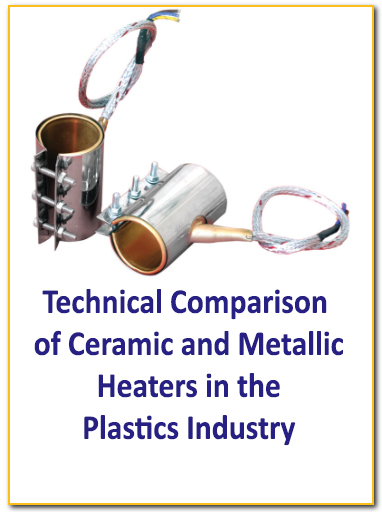
Technical Comparison of Ceramic and Metallic Heaters in the Plastics Industry
Objective: Provide a specialized guide for process, maintenance, and procurement engineers to make the best choice between ceramic and metallic (sheathed) heaters for different plastics processing applications.
1. Quick Overview: Ceramic vs. Metallic
- Ceramic Heaters: Typically ceramic band heaters or segment/tile-type radiant heaters (alumina tiles). Heat transfer is a mix of radiation + convection + conduction. High emissivity surface, ideal for extruder/injection barrels (medium to large sizes).
- Metallic Sheathed Heaters: Cartridge, tubular/finned, mica/steel band, etc. Primary heat transfer via direct conduction with fast thermal response. Suitable for direct contact zones, mold cavities, nozzles, manifolds, and small to medium barrels.
Rule of Thumb:
- For uniform heating and reduced losses on large cylindrical surfaces → Ceramic heaters are more efficient.
- For high heat flux, fast response, and precise point heating → Metallic sheathed heaters are superior.
2. Key Performance Indicators (KPIs)
- Temperature uniformity
- Allowable power density (W/cm²)
- Response time (heat-up/cooling)
- Energy efficiency and losses
- Durability under thermal cycling
- Maintainability and downtime
- Operational safety
- Total cost of ownership (TCO)
3. Heat Transfer Physics (Simplified for Application)
- Conduction: Dominant in cartridge and metallic band heaters; depends on installation tolerance, surface roughness, and clamping force.
- Convection: Relevant in open/chamber areas; insulation reduces convective losses.
- Radiation: Advantage of ceramics; emissivity (ε) of ceramic ≈ 0.85–0.95 vs. polished metals ≈ 0.2–0.3. At the same operating temperature, ceramics radiate more, ensuring better uniformity.
⚠️ Poor contact in metallic heaters → hotspots and premature failure. Ceramics are less sensitive to small gaps thanks to higher radiation share.
4. Technical Comparison Table (Typical Values)
Parameter | Ceramic Band/Segment | Metallic Sheathed (Band/Mica/Cartridge/Tube) |
Continuous Operating Temp | 300–450°C (up to ~600°C) | 200–500°C (cartridge special up to ~700°C) |
Allowable Power Density | 2–7 W/cm² (up to 10 W/cm² special) | 3–20 W/cm² (HD cartridges 25+) |
Thermal Response | Medium | Fast to very fast |
Barrel Temperature Uniformity | Excellent | Good–Very good (contact-dependent) |
Surface Losses w/o Insulation | Lower (ε high) | Higher unless polished/insulated |
Sensitivity to Installation Gaps | Low–Medium | Medium–High |
Initial Cost | Medium–High | Low–Medium (HD cartridges high) |
Maintenance | Easy (modular) | Easy–Medium (cartridges harder to remove) |
Thermal Shock Resistance | Good | Good, but sheath may crack if misinstalled |
Insulation Effectiveness | 10–30% savings | 5–25% savings |
5. Applications in Plastics Processing
- Extrusion (single/twin screw):
- Barrel zones: Ceramic bands + aluminum/steel cover → better uniformity & energy savings.
- Nozzle/cone: Metallic cartridge or compact band → fast response.
- Injection Molding:
- Barrel: Ceramic or mica band (size-dependent). Ceramics usually more efficient.
- Nozzle/manifold: High-density cartridge + sensor near melt point.
- Blow Molding:
- Die heads: Ceramic bands for body + cartridges for critical hot zones.
- Thermoforming/Rotomolding:
- Large-area heating: Ceramic/radiant heaters.
- Local hotspots: Metallic cartridge heaters.
6. Energy Engineering & Insulation
- Barrel covers/insulation → 10–30% energy savings (ceramic), 5–25% (metallic).
- Seal gaps to reduce convective losses.
- Optimize pre-heat/soak cycles to reduce peak load and extend heater life.
7. Control & Instrumentation
- Sensors: T/C type J,K or RTD; RTD preferred for higher accuracy.
- Placement: 1–2 mm from barrel surface or near consumption point.
- PID Control: Adjust tuning to account for thermal inertia; ceramics need longer integral time than metallic.
- Protection: Safety limit controllers, thermal fuses, SSR with proper heat sinking.
8. Durability, Troubleshooting & Maintenance
- Common Failures:
- Cartridges: burnout from poor fit, contamination, wrong rating.
- Mica bands: hotspots due to loose clamp or oval barrel.
- Ceramics: mechanical breakage or loose connectors.
- Maintenance Plan:
- Monthly: Clamp torque, grounding, connectors.
- Quarterly: Sensor calibration, surface cleaning, insulation check.
- Yearly: Infrared thermography, wiring/SSR inspection.
9. Total Cost of Ownership (TCO)
- Ceramic: Higher initial cost, but better energy savings & durability → competitive TCO for medium/large barrels.
- Metallic: Lower upfront cost; best for high-flux point heating.
Rule of Thumb: For >4–6 hrs/day at >250–300°C on large barrels → ceramics + insulation are more cost-effective.
10. Selection by Operating Conditions
Condition | Recommendation |
Large barrel, 250–400°C, energy saving priority | Ceramic band + insulation cover |
Nozzle/manifold, very fast response needed | High-density cartridge |
Budget-limited, ≤300°C | Mica/metallic band |
Strong air flow in environment | Ceramic with cover OR insulated metallic |
Mechanical shock risk | Metallic with strong clamping OR protected ceramic |
11. Example Sizing (Extruder Ø120 mm, Zone Length 250 mm)
- Barrel circumference: π × 0.12 ≈ 0.377 m
- Zone surface area: 0.377 × 0.25 ≈ 0.094 m² (~940 cm²)
- Loss estimate w/ insulation: 0.6 W/cm² → ~564 W
- With 2.5× safety factor: ~1.4 kW
- Recommendation: Two 750 W ceramic bands with independent PID.
⚠️ Without insulation → losses up to 0.9–1.2 W/cm² → required power ~2.1–2.8 kW.
12. Safety & Standards
- Proper grounding (≤1 Ω).
- IP-rated connections against dust/moisture.
- Protective covers for live terminals.
- Relevant standards: IEC/EN 60519 (industrial heating), IEC 60584 (thermocouples), IEC 60751 (RTD).
13. Procurement Checklist
- Exact dimensions (ID/OD/width for bands, dia/length for cartridges).
- Voltage, total power, W/cm² target.
- Operating & ambient temperature, duty cycle.
- Terminal/cable type, IP rating, insulation type.
- Accessories: cover, sensor, thermal fuse, shield.
- Documentation: datasheet, thermal curves, lifetime charts.
14. Common Mistakes & Solutions
- Loose bands or oval barrels → re-machining, stronger clamps.
- Cartridge burnout → wrong fit, rough bore, improper grease, sensor far away.
- Excessive temp swings → poorly tuned PID, low-grade sensor, SSR overheating.
15. FAQ (Quick Answers)
- Can ceramic bands replace mica bands? → Yes, usually same dimensions, check power rating & connections.
- For heat-sensitive polymers (PVC, POM)? → Sensor placement & control quality matter more than heater type.
- Service life? → From several thousand to tens of thousands of hours, depending on quality and installation.
16. Executive Summary
- For large surfaces, high temp, and energy savings → Ceramic with insulation is the first choice.
- For fast, localized heating (nozzle/manifold) → Metallic cartridges/tubular heaters excel.
- Installation quality, sensor placement, and tuned PID are often more critical than the heater type itself.
✅ Upon request, customized sizing and BOM recommendations can be provided based on machine type, dimensions, and thermal profile.
CLICK HERE

CLICK HERE